Thursday, August 18, 2016

Samsung Galaxy Note 7 Reviews:Things you didn't know about
Pre-ordering, news and features you never knew about the best 2016's Samsung Phone with extremely larger curved screen of 5.7 inch, with an S Pen stylus, powered with a super efficient battery. That is Galaxy Note 7!

Samsung Galaxy Note 7 Release date

In the internet there have been many rumors about the release date of this Samsung's brand new Phone. But the real date which is set for the release of the Galaxy Note 7 in US is August 19. Also it's the the same as in Australia.

Three days after its release in IU.S.A and Australia, it will be launched in UK. That is September 2.

NOTE! Pre-orders In the UK was launch in August 16.

Samsung Galaxy Note 7 price

The price of the Galaxy Note 7 in the US is between $33 and $36.67 a month on device payment plans with AT&T, Verizon, T-Mobile or Sprint Carriers.

Without a contract, it's anywhere from $850 (T-Mobile and Sprint) to $880 (AT&T).

Sprint is the only one offering old two-year contracts in exchange for $350 upfront.

The Note 7 price in UK is £749. 
And in Australia is AU$1,349.

But if you Pre-order in certain stores, you'll receive a bonus: either a Samsung Gear Fit 2 fitness tracker or a Samsung 256 GB microSD card, your choice. Shop around.

The best advices of all the time from my co-worker

I think people need to distinguish phone for work and for entertainment. S7 is for entertainment, just like iPhone and many others. Note is for work. I am at lost now after upgrading to S7 from Note 3. 

Really. That pen, is my life, if you are a businessman. You need it to explain to your client, you need it to take note when you meet clients. You need it to sketch your design. 


You need it to draw component, you need it to draw your flowchart, you need it to illustrate your point. You need it to take moments of meeting. You need it to to tell your audience graphically.

Try to tell your customer which object connect easily with sentences. 7 symbols, and few lines between them will show their relationship, you have to write a full page for that diagram. 
samsung-galaxy-s7
So, I think you are really missing the point of having a note. Perhaps, one day when you have throw your tablet and laptop, you'll appreciate what note gives you. I do, since after I owned note 2, I only carry one thing in my pocket, and one thing only. Galaxy Note. It holds my rfid keys, my cards, my meeting moments, my drawings, my reminders, my business secrets, CCTV videos, my signed contract agreements, and many other thing. With this one device, I don't need any tablet nor notebook, not even agenda or scrap paper and definitely not a traditional pen.

The other person can also see things in this way.

As a rabid fan of the Note series, I'm stunningly disappointed in this release. Samsung has again crippled this phone, as they did with the Note 5. How so?

1) No removable battery is a *terrible* thing to do to a phone, saddling users with a battery that degrades from day 1 (even more so when using quick-charge technology) and no way to replace the battery without a huge bill. Plus, no matter how fast your fast charging tech is, it can't go from 0% to 100% in less than 30 seconds like the Note 4 can. 


If LG can find a way to keep removable batteries (and it's done it well with the G5, and with the almost-ready V20) then Samsung has NO excuse. When your battery dies and you're not lugging your charger & cord, and close to an outlet... enjoy your $1000 paperweight.

2) Removing the IR blaster for TV/Stereo/etc remote control is hugely aggravating. The Note 3 and 4 were excellent universal remote devices, and now we're back to 4 remotes sliding down the couch cushions next to the popcorn kernels. Great.

3) Removing the shatter-proof back of the phone, replacing with glass that often breaks when dropped. I swear if I hear one more wanna-be hipster saying "but muh premium materials!" I'll grab him by the man-bun. Seriously, tech journalists are *just* as guilty for making this an issue, when it simply is not. Hey newsflash: Your $1000 phone belongs in a case!! And now your fancy premium finish (which you just sacrificed several key features for) is moot. Happy now??

4) Only 4GB RAM. Seriously Samsung? Google is about to release the first ever version of Android which properly supports real multi-tasking (where RAM is key), and you give us the same tired 4 Gigs of RAM as last year's phone?? When it's proven possible to go 6 Gigs, because that's what you're releasing in CHINA??? Wow. Just wow.

5) Only 64GB onboard storage. Again, in 2016 this is a crime. Yes, you can add a 256GB microSD card (halleluyah, they un-crippled something!) but really, in a flagship phone, 64 is a minimum, not a maximum spec.

So there are 5 key areas that the Note 7 is seriously flawed, and very arguably a downgrade from the Note 4. But Techradar's review calls it the perfect phone... Seriously? LG's V20 flagship (removable battery, IR blaster, second screen, Quad DAC hi-fidelity audio, Android Nougat, etc etc) is shaping up to be a MUCH better phone, if you can live without the stylus. Save your money and wait for the V20.
Tuesday, July 12, 2016

Cheap Unlocked Smartphones Under $100 at Walmart - Best BLU's budget 2017
Top suggestions of the best BLU Phones under 100 USD

We have prepared our Top picks and suggestions of the best smartphones on this beginning of the third Quarter of the year 2017. We are going to see the Best and cheap prepaid and Unlocked Smartphones from Walmart, the best U.S smartphone suppliers and at Amazon.

Related: Top Best Cheap Smartphone in Walmart under $20 to buy 2017

Out of the Cheapest Smartphones sold under 20 Dollars on Walmart as we saw on our previous Article, Below are Other phones which can be bought by those with their budget under $100. These cell phones have super best specifications and good battery life w.r.t to their price. These 2017 best unlocked smartphone list aims to help you not to spend much from your budget so as not to exceed the limit that you planned to spend on buying a smart phone.

Cheap Unlocked BLU Smartphones at Walmart | amazon  
Have you ever heard about This US BLU Phone Maker?. I guess Most may say No but those who are good Sellers and Buyers of Unlocked Smartphone from United States will surely say YES! Well, From my experience, i have seen that BLU gives the best smartphone for the budget below 100 bucks among other phone manufactures who sells their handsets starting at extremely low price. Let's go and see these BLU Phone's models below 

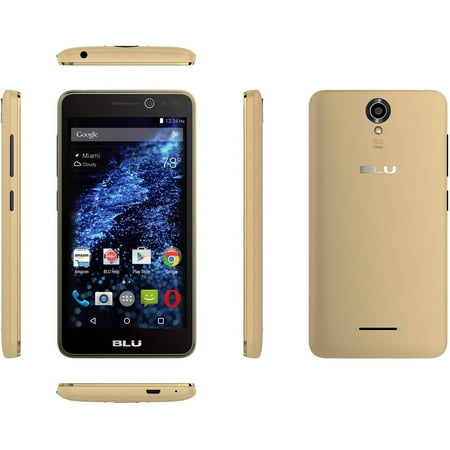
2. BLU Studio Selfie S070Q - Gold 


Blu-studio-selfie-s070q
Price:  $79.00 at Walmart or $74.87 at Amazon 


This BLU studio Selfie is Unlocked Smartphone which offers good performance on its 5 megapixels front and real Cameras. It has a Flash light which ensures you full possibility of taking photos even an night or dark places without fear of capturing buggy images to fill up your memory. It also has 8GB expandable Memory and some advanced features compared to other Prepaid and unlocked smartphones which are found at this price. Other colors available for this Model are Grey and White 

BLU Studio Selfie S070q Specs

    • microSD card slot
    • With 2G: GSM 850/900/1800/1900, 3G/HSPA+: 850/1700/1900/2100
    • WiFi 802.11 b/g/n, hotspot
    • Bluetooth: v2.1, A2DP, EDR
    • Internal Memory: 8GB, 1GB RAM, microSD slot expandable up to 64GB
    • USB: microUSB v2.0
    • GPS: with A-GPS
    • Android v5.0.2 (Lollipop)
    • Five-megapixel camera (2592 x 1944 pixels) with LED flash and front-facing 5-megapixel camera
    • Powered by a 1.3GHz Quad-core Mediatek MT6580 processor
    • Browser: HTML
    • Long-lasting 2000mAh battery
    • Vivid 5.0" IPS LCD capacitive multi-touchscreen
    • Onscreen keyboard
    • Touch navigation
    • SMS (threaded view)
    • MMS
    • Email
    • Push Email
    • IM
    • Phone
    • Battery
    • Wall charger
    • USB data cable
    • Headset
    • Silicone case
    • Screen protector
    • User guide

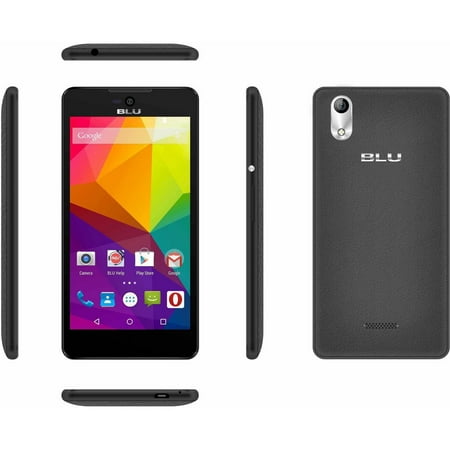
1. BLU Studio C5+5 D890u


BLU-Studio-C-5+5-Unlocked-Android -Smartphone
Price:  $74.87 - $79.99 at Walmart or $74.87 at Amazon 

This Unlocked Android powered BLU Smartphone. The Studio C5+5 runs Android 5.0 Lollipop Operating System  

It has 8GB internal memory | 5MP camera | Micro SD slot
4G LTE Capabilities

The BLU Phones Can be used with cricket Carrier

Compatible with Tracfone, Straigh talk 4G network,
D890u GSM Dual-SIM

All Blu phones come factory unlocked so they work with Verizon as well.

Below are Overall Specifications of the Unlocked D890u BLU Studio Phone  

    • MicroSD slot
    • 2G: GSM 850/900/1800/1900, 3G: HSDPA 850/1700/1900
    • Bluetooth v.4.0
    • MicroUSB 2.0 port
    • WLAN: 802.11 b/g/n
    • Android 5.0 (Lollipop) OS
    • 5-megapixel camera with LED flash ( front-facing )
    • BLU Studio smartphone, (unlocked) is video capable
    • Quad-core Cortex-A7 1.3GHz processor
    • Browser: HTML5
    • 8GB internal memory
    • 1GB RAM
    • GPS with A-GPS
    • Battery: lithium-ion 2000mAh offers the average Standby time of Up to 750 h
    • and Talk time of up to 10 h
    • 5" IPS LCD touchscreen
    • Onscreen keyboard
    • Touch navigation
    • It sends SMS, Email, push mail and MMS
    • Instant messaging
    • Wall charger
    • microUSB cable
    • In-ear headphones
    • Screen protector
    • Silicone case
    • Available in 7 different colors which are gold, blue, pink, orange, green, white and black

I suppose for $50 one shouldn't expect much, and not much is exactly what one does get. But anyone on an extremely tight budget (and the right carrier) It's a good bargain.Enjoy the savings!

I've prepared a Roundup review from one of the Blue phone user below.

I got the Blu Energy X Plus in November. 5.5" screen with a big battery for $112 (it was on sale but was regularly only around $129, I think). I use it on Straight Talk which uses Verizon and AT&T towers, depending on your phone. My biggest gripe is that Blu doesn't work with Verizon which are my preferred towers in my area.

It's a very pretty phone compared to the other cheapies. A nice display but I have noticed a bit of streaking once in a great while recently, but only with certain odd images (perhaps lots of white). Just replace the launcher with something from the Play store and you'll probably be happier with the interface. I've used Google Now and Nova. Both are better than what the phone comes with and they're free.

Mine has dual SIM slots but I only use one. It takes a micro SD card (mine has a 64GB).

I really don't worry too much about Android updates because no company ever seems to update their lower phones. Just buy a new model which will have a faster processor, etc, whenever you really really want the update. I can't say I've ever run into an app that wouldn't run on any out of date Android I've ever had.

People seem impressed when they see mine and are surprised at the price.

Yes, the camera could be better. Once every couple of weeks it will do a random reboot shortly after turning it on. I really can't complain too much. Whenever I decide to swap phones, I suspect it'll be another Blu. It's not perfect but I'm not going to pay $500 or more for a supposedly more reliable phone

Sunday, July 10, 2016

Best Solar Powered Outdoor Lights 2016 + Battery and LED Tips
Where to start? I guess the basics of Solar panels, Battery and LED's Lumens are the ones to start with in our guide to the best solar lighting on 2016.
best-solar-powered-lights

Solar panels:

There are three distinct types. 
  1. Monocrystaline, 
  2. polycrystalline and 
  3. amorphous. 
Mono is considered the best overall performer, followed by polycrystalline. Amorphous are the ones used in calculators and the cheapest solar products.

Polycrystalline are somewhat easy to spot because there appear to be "flakes" on the surface of the solar cells. Monocrystalline are what you'll find in higher priced pieces that look to have a smooth even appearance. All of these types can come laminated with a glass cover, but most amorphous are not. They are sealed over the top with glue and will become yellowed in time.

Batteries. 

The cheapest and least environmentally friendly are the nickel cadmium (NiCad) batteries. These are environmentally damaging in production and in disposal. They have a "memory" - meaning they must fully discharge to gain the longest useful life from them. They will last perhaps one season at best and do not have large storage capacity (maximum about 900mAh).

Next best are nickel metal hydride (NiMH) batteries. These batteries have little environmental consequence, though they, like all rechargeable batteries, should be recycled. They have no memory, so they do not need to be fully discharged to gain the most useful life. They have large storage capacities (upwards of 2600 mAh), and they have about twice the lifecycle of the NiCAD. Both NiCad and NiMH have shelf life drainage. Meaning, they will die out on the shelf.

Most solar lamp suppliers include instructions to charge the solar lamps for 48 hours before first use. That is because they may have NiCad or NiMH batteries that have drained completely while sitting on the shelf. It will take the NiMH batteries 5 ~ 10 charging cycles before they fully gain their potential.

Finally, the lithium battery. These LiFePO4 batteries are the king when it comes to performance. They pose little if any environmental threats, have huge storage capacities, no memory, have minimal shelf life drain, and last for up to 3 years.

Also read: 3 Best Solar Powered Lights - Buying Guide and Tips

Okay, so now about LEDs.

Just because an LED emits a blue hue does not mean it is a lesser quality LED. It only means the phosphors that are use are at the colder end of the kelvin scale (whiteness in LEDs is expressed in degrees K). The higher the degrees K, the whiter it will be. Warm white LEDs are within the 2700K ~ 3200K range. White begins at 4500K and becomes a bluish white at 5500K. The measure of light output is expressed in lumens. The base by which retailers express, for example, their "10X Brighter" statements is a measure against the 1.2 lumen bottom-of-the-line LED product. Spotlights with 50+ lumens are suitable for garden lighting, but wouldn't light up a tree or side of your house. For lumen output of 100+, you'll look to spend upwards of $100. 

As to LEDs, the bluer LEDs are not of lesser quality, they are just cheaper. Much more complex mixes of phosphors are required to get the warmer temperatures. 

So, when shopping for solar, remember good/better/best is going to be the combination of;
  1. Solar panels (Amorphous/Polycrystalline/Monocrystalline; 
  2. Batteries (NiCad/NiHM/LiFePO4); and 
  3. lumens (the higher the lumens, the brighter the solar lamp).
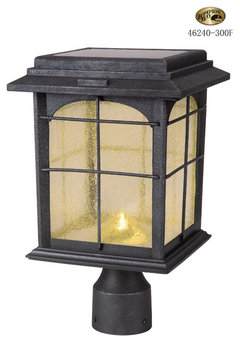
Here is a photo of a high quality solar post lantern sold at Home Depot. It employs a monocrystalline solar panel, lithium batteries, and is rated 135 Lumens.


A couple of things to remember about the current crop of solar lights is that they are made for mass-marketing. The key to this is "make them as cheap as possible". The performance of a solar cell is roughly defined by how much power a cell can produce for a given surface area, or in engineering terms it is how much of the sunlight energy gets converted to power (i.e, efficiency).

A manufacture will choose the cheapest cell type that meets the power requirements and still fits within the lights designed dimensions. Some of the Chinese manufacturers may use scrap cells from other solar cell productions (like broken pieces from larger cells that can be re-cut into useable product) that may be of a higher quality than others, allowing them to use a slightly smaller part. Either way, the lifespan of most any cell is measured in decades, far longer than the expected lifespan of the light. What this all boils down to is choosing the cell that has the best protection from the elements thereby ensuring the longest useful life, and not fretting over the underlying cell chemistry.

NiCads need to discharge fully to get maximum life (number of cycles)
 as stated above. This is exactly the environment of solar yard lights. Their temperature and overcharging tolerance, low cost, and general robustness make them ideal. Many NiCad lights I have dissected don't even use a charging regulator, the solar cell charges the battery directly. In these designs the cell is chosen such that its power output is below the level that could damage the NiCad by over charging. 

Alas the NiCad is not prized for being environmentally friendly. I have not seen any NiMH batteries in the lights I have dissected (Though I assume there are some out there!). My assumptions for this are as follows. 

NiMH batteries have more delicate charging requirements than NiCads. This requires the light manufacturer to install some form of charging control (at an added expense). The cost/charge cycle is about 3X higher for NiMH over NiCad (given proper maintenance such as operating temperature and full discharges for NiCads). Of course the manufacturer will consider this when deciding on a battery technology. You may disagree with me on the lifecycle count being higher for NiMH. All information I have puts NiCad at about 3x-5x longer life (again, with proper maintenance).

NiMH does have a superior energy density, that is where one AA cell NiMH will hold about the same amount of charge as two AA cell NiCads. If the manufacturer can recoup the higher costs of NiMH by reducing the size of their light, then NiMH would have an advantage. Of course the 'greenness' of NiMH versus the cadmium toxicity of NiCad may become an overriding factor. Lithium is indeed the 'king' for all of the above performance parameters, but the much higher cost and required charging circuitry will keep these out of the lowest end of the yard light market (i.e. the $1 WalMart specials).

As an aside, I bought several $10 solar floods and lo and behold, they use lithium batteries! Everything about these lights spells cheap. My guess for the choice of lithium is 
  • The greater energy storage needs to run a flood light overnight, 
  • The non-toxicity for marketing/environmental compliance.

Round Up

Final Verdict for shopping criteria with some the exception of the solar cell. Technology doesn't matter as the dominating consideration should be the protective layer over the cell. Simple coatings are the worst (will yellow/flake off), plastic covers will eventually cloud, glass will last years.

With more money spent, you will get the better technologies. Manufactures will make the light as cheap as possible while meeting the lighting requirements so you don't really have a choice except to pick what fits your needs.