Where to start? I guess the basics of Solar panels, Battery and LED's Lumens are the ones to start with in our guide to the best solar lighting on 2016.

So, when shopping for solar, remember good/better/best is going to be the combination of;

Solar panels:
There are three distinct types.
- Monocrystaline,
- polycrystalline and
- amorphous.
Mono is considered the best overall performer, followed by polycrystalline. Amorphous are the ones used in calculators and the cheapest solar products.
Polycrystalline are somewhat easy to spot because there appear to be "flakes" on the surface of the solar cells. Monocrystalline are what you'll find in higher priced pieces that look to have a smooth even appearance. All of these types can come laminated with a glass cover, but most amorphous are not. They are sealed over the top with glue and will become yellowed in time.
Batteries.
The cheapest and least environmentally friendly are the nickel cadmium (NiCad) batteries. These are environmentally damaging in production and in disposal. They have a "memory" - meaning they must fully discharge to gain the longest useful life from them. They will last perhaps one season at best and do not have large storage capacity (maximum about 900mAh).
Next best are nickel metal hydride (NiMH) batteries. These batteries have little environmental consequence, though they, like all rechargeable batteries, should be recycled. They have no memory, so they do not need to be fully discharged to gain the most useful life. They have large storage capacities (upwards of 2600 mAh), and they have about twice the lifecycle of the NiCAD. Both NiCad and NiMH have shelf life drainage. Meaning, they will die out on the shelf.
Most solar lamp suppliers include instructions to charge the solar lamps for 48 hours before first use. That is because they may have NiCad or NiMH batteries that have drained completely while sitting on the shelf. It will take the NiMH batteries 5 ~ 10 charging cycles before they fully gain their potential.
Finally, the lithium battery. These LiFePO4 batteries are the king when it comes to performance. They pose little if any environmental threats, have huge storage capacities, no memory, have minimal shelf life drain, and last for up to 3 years.
Next best are nickel metal hydride (NiMH) batteries. These batteries have little environmental consequence, though they, like all rechargeable batteries, should be recycled. They have no memory, so they do not need to be fully discharged to gain the most useful life. They have large storage capacities (upwards of 2600 mAh), and they have about twice the lifecycle of the NiCAD. Both NiCad and NiMH have shelf life drainage. Meaning, they will die out on the shelf.
Most solar lamp suppliers include instructions to charge the solar lamps for 48 hours before first use. That is because they may have NiCad or NiMH batteries that have drained completely while sitting on the shelf. It will take the NiMH batteries 5 ~ 10 charging cycles before they fully gain their potential.
Finally, the lithium battery. These LiFePO4 batteries are the king when it comes to performance. They pose little if any environmental threats, have huge storage capacities, no memory, have minimal shelf life drain, and last for up to 3 years.
Also read: 3 Best Solar Powered Lights - Buying Guide and Tips
Okay, so now about LEDs.
Just because an LED emits a blue hue does not mean it is a lesser quality LED. It only means the phosphors that are use are at the colder end of the kelvin scale (whiteness in LEDs is expressed in degrees K). The higher the degrees K, the whiter it will be. Warm white LEDs are within the 2700K ~ 3200K range. White begins at 4500K and becomes a bluish white at 5500K. The measure of light output is expressed in lumens. The base by which retailers express, for example, their "10X Brighter" statements is a measure against the 1.2 lumen bottom-of-the-line LED product. Spotlights with 50+ lumens are suitable for garden lighting, but wouldn't light up a tree or side of your house. For lumen output of 100+, you'll look to spend upwards of $100.
As to LEDs, the bluer LEDs are not of lesser quality, they are just cheaper. Much more complex mixes of phosphors are required to get the warmer temperatures.
So, when shopping for solar, remember good/better/best is going to be the combination of;
- Solar panels (Amorphous/Polycrystalline/Monocrystalline;
- Batteries (NiCad/NiHM/LiFePO4); and
- lumens (the higher the lumens, the brighter the solar lamp).
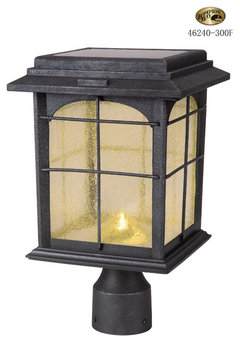
Here is a photo of a high quality solar post lantern sold at Home Depot. It employs a monocrystalline solar panel, lithium batteries, and is rated 135 Lumens.
A couple of things to remember about the current crop of solar lights is that they are made for mass-marketing. The key to this is "make them as cheap as possible". The performance of a solar cell is roughly defined by how much power a cell can produce for a given surface area, or in engineering terms it is how much of the sunlight energy gets converted to power (i.e, efficiency).
Alas the NiCad is not prized for being environmentally friendly. I have not seen any NiMH batteries in the lights I have dissected (Though I assume there are some out there!). My assumptions for this are as follows.
With more money spent, you will get the better technologies. Manufactures will make the light as cheap as possible while meeting the lighting requirements so you don't really have a choice except to pick what fits your needs.
A manufacture will choose the cheapest cell type that meets the power requirements and still fits within the lights designed dimensions. Some of the Chinese manufacturers may use scrap cells from other solar cell productions (like broken pieces from larger cells that can be re-cut into useable product) that may be of a higher quality than others, allowing them to use a slightly smaller part. Either way, the lifespan of most any cell is measured in decades, far longer than the expected lifespan of the light. What this all boils down to is choosing the cell that has the best protection from the elements thereby ensuring the longest useful life, and not fretting over the underlying cell chemistry.
NiCads need to discharge fully to get maximum life (number of cycles) as stated above. This is exactly the environment of solar yard lights. Their temperature and overcharging tolerance, low cost, and general robustness make them ideal. Many NiCad lights I have dissected don't even use a charging regulator, the solar cell charges the battery directly. In these designs the cell is chosen such that its power output is below the level that could damage the NiCad by over charging.
NiCads need to discharge fully to get maximum life (number of cycles) as stated above. This is exactly the environment of solar yard lights. Their temperature and overcharging tolerance, low cost, and general robustness make them ideal. Many NiCad lights I have dissected don't even use a charging regulator, the solar cell charges the battery directly. In these designs the cell is chosen such that its power output is below the level that could damage the NiCad by over charging.
Alas the NiCad is not prized for being environmentally friendly. I have not seen any NiMH batteries in the lights I have dissected (Though I assume there are some out there!). My assumptions for this are as follows.
NiMH batteries have more delicate charging requirements than NiCads. This requires the light manufacturer to install some form of charging control (at an added expense). The cost/charge cycle is about 3X higher for NiMH over NiCad (given proper maintenance such as operating temperature and full discharges for NiCads). Of course the manufacturer will consider this when deciding on a battery technology. You may disagree with me on the lifecycle count being higher for NiMH. All information I have puts NiCad at about 3x-5x longer life (again, with proper maintenance).
NiMH does have a superior energy density, that is where one AA cell NiMH will hold about the same amount of charge as two AA cell NiCads. If the manufacturer can recoup the higher costs of NiMH by reducing the size of their light, then NiMH would have an advantage. Of course the 'greenness' of NiMH versus the cadmium toxicity of NiCad may become an overriding factor. Lithium is indeed the 'king' for all of the above performance parameters, but the much higher cost and required charging circuitry will keep these out of the lowest end of the yard light market (i.e. the $1 WalMart specials).
As an aside, I bought several $10 solar floods and lo and behold, they use lithium batteries! Everything about these lights spells cheap. My guess for the choice of lithium is
As an aside, I bought several $10 solar floods and lo and behold, they use lithium batteries! Everything about these lights spells cheap. My guess for the choice of lithium is
- The greater energy storage needs to run a flood light overnight,
- The non-toxicity for marketing/environmental compliance.
Round Up
Final Verdict for shopping criteria with some the exception of the solar cell. Technology doesn't matter as the dominating consideration should be the protective layer over the cell. Simple coatings are the worst (will yellow/flake off), plastic covers will eventually cloud, glass will last years.With more money spent, you will get the better technologies. Manufactures will make the light as cheap as possible while meeting the lighting requirements so you don't really have a choice except to pick what fits your needs.


![CODE TO HIDE GOOGLE ADSENSE; TRANSPARENT ADS OVER VIDEO PLAY BUTTON [2016 TRICK]](https://blogger.googleusercontent.com/img/b/R29vZ2xl/AVvXsEiGeTmQoSZf1STI5ExGEyD9goxlRjHU7dis1lUJZvXpQombSIHVDtIDSHuyHJPnf0xaSThAe3Qm_vd6liBrgQLBbaU2-787q3i03MBiHukt2-EdsJyla_cCxStEJEiDh61yqwLFNT3XBku5/s72-c/Screenshot_2016-02-23-23-35-19.png "CODE TO HIDE GOOGLE ADSENSE; TRANSPARENT ADS OVER VIDEO PLAY BUTTON [2016 TRICK]")
![[Updated 2017 ] Top 5 Google Adsense Earning Tricks 2016 And High CPC Tips](https://blogger.googleusercontent.com/img/b/R29vZ2xl/AVvXsEjI6AHme91WNQA8T7_7zyeCA5xLLlUH8OpvkGphY-lt7eW__TBHZ-CcOSSRth_jloAQJbQ4ByC0lSz35BxOoEOXujYTIoF9dYbhMGD1s4ycZOh1qNDpC43ozdYOjKnomadAqr9MU9bdgDrq/s72-c/top+5+adsense+earning+tricks+and+high+cpc+increasing+tips.jpg "[Updated 2017 ] Top 5 Google Adsense Earning Tricks 2016 And High CPC Tips")


